
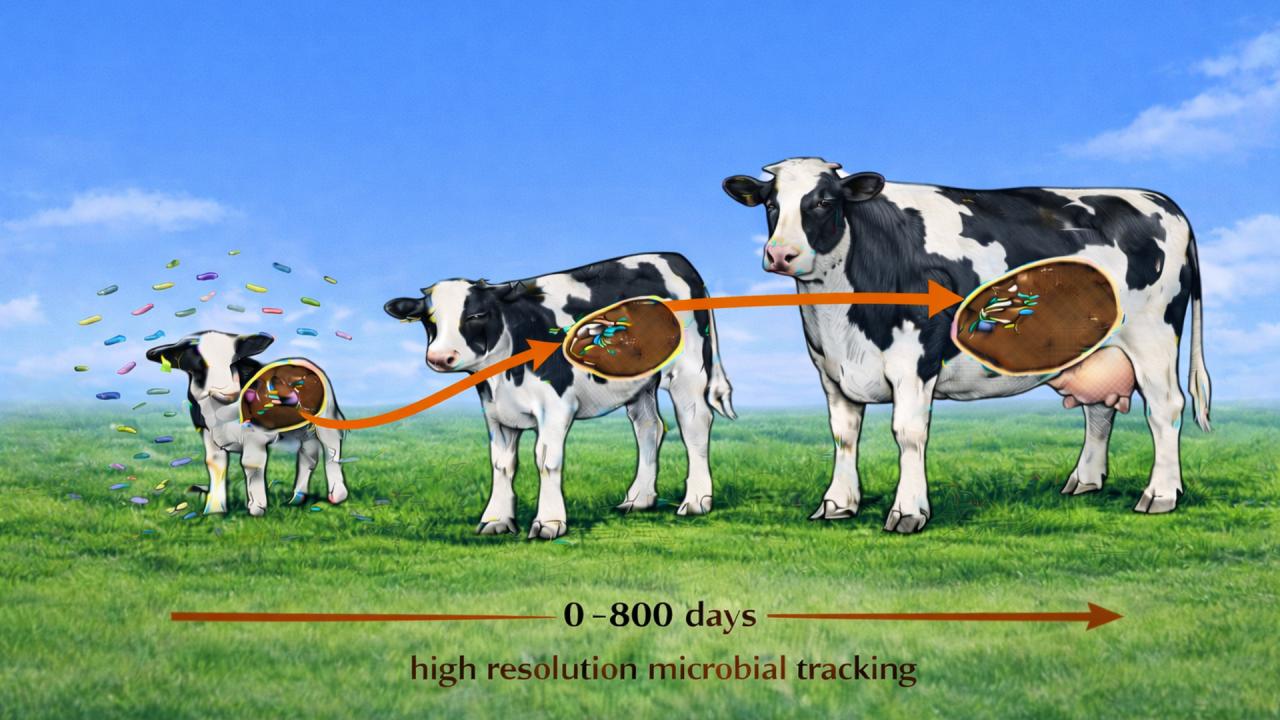
Some microbes arrive early. Others arrive late. But a special group arrives early and never really leaves. Why didn’t we detect them until now? What are they actually doing there? Do they actively contribute, or are they simply along for the ride?
In this blog, we step back from the figures and statistics and share the story behind our study published in The ISME Journal “Persistent auxiliary microbiome of early novel colonizers in the developing rumen with lasting functional significance“. We focus on this overlooked group, which we term the auxiliary rumen microbiome, microbes that colonize the rumen early in life and continue shaping rumen function well into adulthood.
We describe the main findings in simple terms and walk through the path we took to uncover this previously hidden microbial layer.
We discuss why early life has remained largely unexplored in rumen microbiome research, how following animals from birth to adulthood changed our perspective, and how genome-resolved analyses allowed us to move beyond asking “who is there” to understanding “what they do” and “how they interact” over time.
We hope you enjoy it!
In earlier work, we followed the developing rumen of animals from birth to almost three years of age (Furman et al.,2021) and identified clear patterns of microbial succession. We also showed that even brief disturbances during early rumen colonization can alter microbiome assembly trajectories, with effects that persist throughout life.
However, a key question remained unresolved: what functions do early rumen colonizers perform, how do they interact with the developing ecosystem, and do their effects persist as the rumen matures?
Not core. Not transient. Auxiliary.
Most rumen microbiome studies focus on adult animals and on the core microbiome, the persistent microbes found in most fully developed rumen ecosystems (see our earlier blog for background). Indeed, several studies, including our own as early as 2013 (Jami et al.), showed that some adult microbes are already present early in life; we now know that most of these belong to the core rumen microbiome.
What we describe here is not the core.
Instead, we uncover additional microbial groups that have largely been overlooked. These microbes escaped attention because early rumen life stages have historically been undersampled and poorly resolved. By applying deep, longitudinal genome-resolved metagenomics across development, from birth to 800 days, we were able to assemble genomes from life stages that had previously remained untapped.
As a result, we uncovered a much larger rumen microbial universe, including 517 previously unknown early-arriving genomes and 10 taxonomic orders that were entirely missing from existing rumen genome collections.
These microbes were not rare. They were simply invisible until we looked at the right time, at sufficient resolution.
These newly recovered lineages form the auxiliary rumen microbiome. They are distinct from the core, enriched in specific metabolic functions, and persistent across development despite declining in abundance.
What distinguishes auxiliary microbes is not how abundant they are, but what they do. Their genomes encode functions that help run and stabilize the ecosystem rather than simply maximize growth. This includes extensive capacity for amino acid, vitamin, and cofactor biosynthesis, volatile fatty acid metabolism, and environmental sensing and stress response.
Auxiliary microbes do not replace the adult core microbiome. Instead, they support it. Not all auxiliary microbes are shared across all animals in the way core microbes are, but in most cases they contribute overlapping functional roles that help sustain rumen performance.
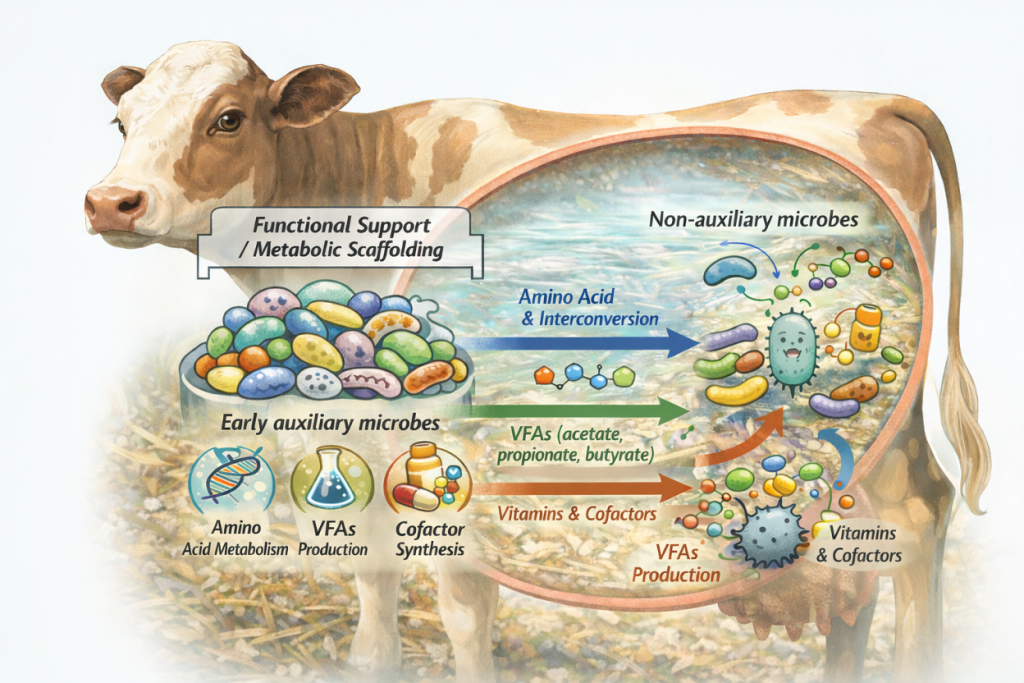
Figure 2: Early auxiliary microbes provide metabolic scaffolding for non-auxiliary microbes in the rumen.Within the bovine rumen, early auxiliary microbes supply amino acids, VFAs, and cofactors that support the metabolic functions of non-auxiliary, late-arriving microbes.
Working across time
One of the most striking findings of this work is that auxiliary microbes often complete metabolic pathways for microbes that arrive later. In simple terms, early microbes help finish the metabolic jobs of adult microbes.
The rumen microbiome is therefore not built in clean stages where one group replaces another. It is assembled layer by layer, with early auxiliary microbes forming a persistent functional backbone beneath the adult core.

Figure 3: Diet- and age-dependent clustering reveals persistent functional roles of early auxiliary genomes. Early auxiliary genomes occupy a larger fraction of the rumen microbiome at early time points but remain detectable throughout life. Shown is the total relative abundance of early auxiliary genomes (dark purple) and non-auxiliary adult taxa (light purple) across time and across all animals. Total microbial abundance represents the summed coverage of all genomes at each time point, normalized to 100%. Boxplots show the relative abundance of the most abundant early auxiliary genome within each time point.
A genome-informed view of microbial interactions
To uncover these interactions, we went beyond listing which microbes are present and used a genome-based metabolic modeling approach. Reconstructed genomes were translated into metabolic networks, allowing us to explore functional potential and metabolic dependencies across time.
This approach helped us identify where pathways were incomplete in some microbes and complemented by others, and to follow how these metabolic handoffs persist from early life into adulthood.
By combining longitudinal data with genome scale reconstructions, we could link early colonizers to later ecosystem function without overinterpreting simple co occurrence patterns.
Why this matters
The rumen microbiome controls feed efficiency, animal productivity, and methane emissions. If auxiliary microbes help stabilize fermentation and resource flow across life, then early life becomes a critical window for shaping long term rumen function.
A shift in perspective
Early-life microbes are not just part of the beginning. They are part of the system, helping stabilize it over time.
By recognizing the auxiliary rumen microbiome, we gain a new way to think about microbiome assembly, resilience, and intervention, starting from day one, with effects that last a lifetime.
With appreciation to the European Research Council (ERC), HoloRuminant, and Israel Science Foundation for their support.