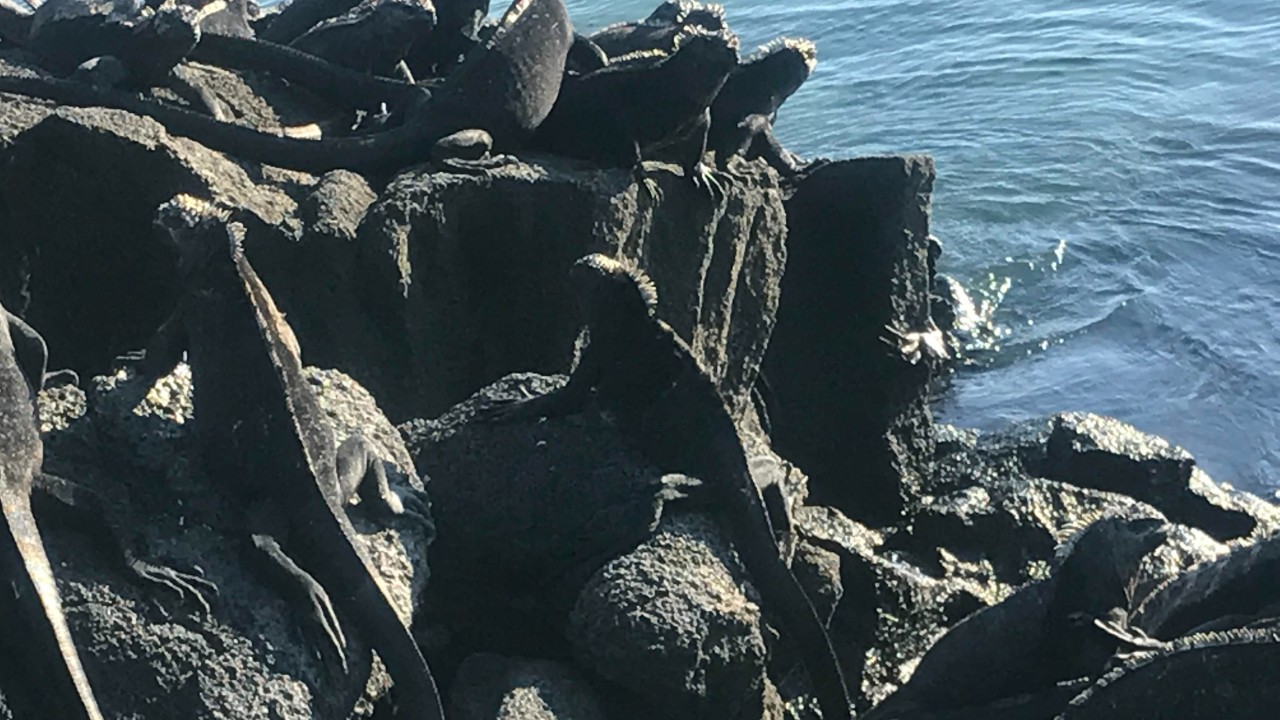
Marine iguanas are the only marine lizards on Earth, unless you count Godzilla. But what if their real uniqueness lies inside them?
In our recent work, we found that these animals host microbial ecosystems that are just as unique as the iguanas themselves. Lose the animal, and you may lose an entire invisible world.
You can read more in our recent publication led by Ido Grinshpan, where we explore how these microbial systems assemble and are shared among iguanas:
Grinshpan, I., Lavy, O., Zorea, A., Amit, I., Levin, L., Furman, O., Somekh, D., Guevara, N., Moraïs, S., Cordero, O. X., & Mizrahi, I. (2026). Endemic within endemics: the microbiota of the Galápagos marine iguanas. ISME Communications, 6(1), ycag040. https://doi.org/10.1093/ismeco/ycag040
Here, I provide a short, accessible summary of our main findings and ideas.
Islands that shaped how we understand life
The Galápagos Islands are not just beautiful. They changed how we understand life itself. It was here that Charles Darwin began shaping the ideas that became the theory of evolution. By observing how species differ from island to island, he realized that isolation and environment shape life over time. Each island is a small, relatively closed system, and because of that, they act as natural laboratories where evolution can be observed in action.
Looking beyond what we can see
For years, scientists focused on the animals and plants we can see. But there is another layer we are only beginning to explore: the invisible world of microbes living inside these animals. This raises a simple question. If the animals on these islands are unique, could the microbial worlds inside them be unique as well?
Endemic species and the ecosystems they carry
Many Galápagos species are endemic, meaning they exist nowhere else on Earth. They evolved under very specific conditions, shaped by isolation, diet, and environment. But isolation does not only affect the animal itself. It shapes everything that lives with it, including its microbes. In that sense, an animal is not just an individual. It is an ecosystem.
Meet the marine iguana: a kind of ocean cow
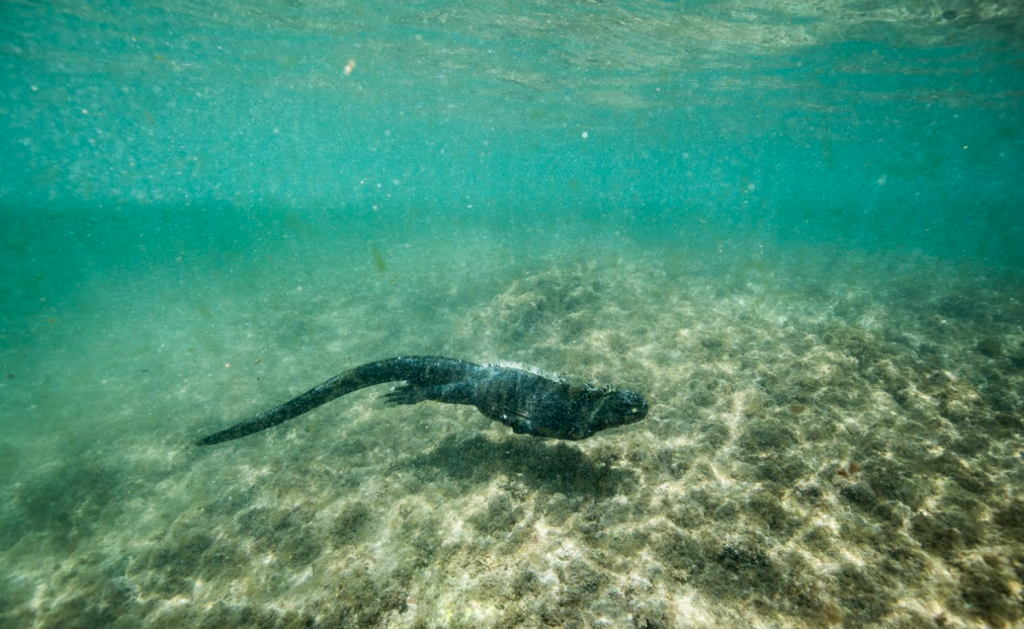
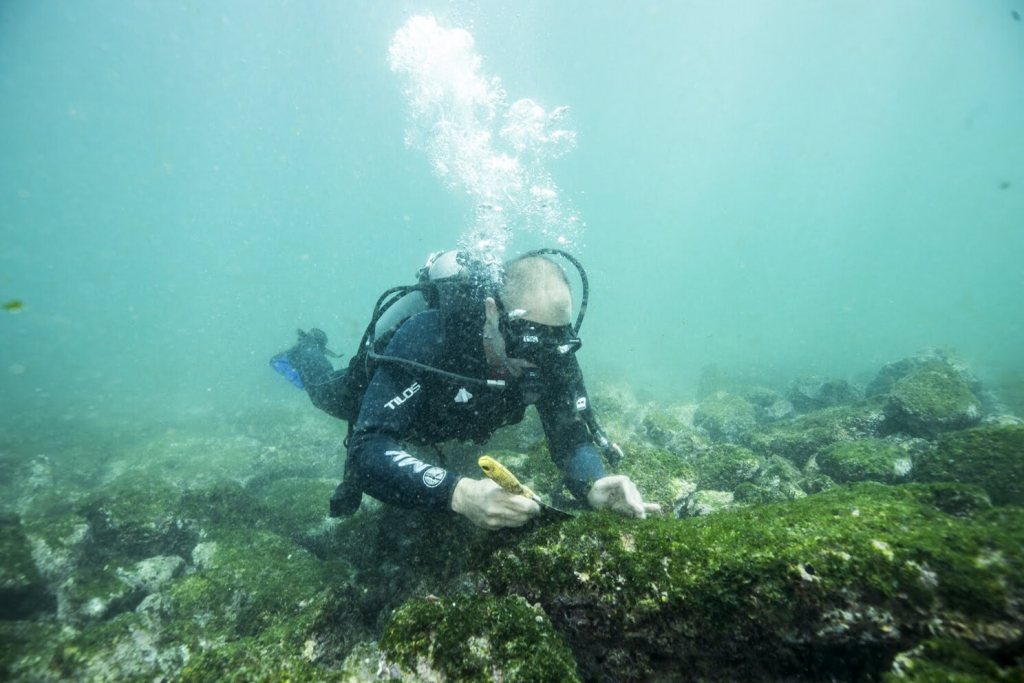
Marine iguanas are one of the most unusual animals on Earth. They are the only sea-going lizards, diving into the ocean to feed almost entirely on algae, especially sea lettuce (Ulva), see Figure 3. But they cannot digest this food on their own. Just like cows rely on microbes to digest grass, marine iguanas rely completely on their gut microbes to break down algae and turn it into energy. Different environments, same principle. Life depends on microbes.
The questions we couldn’t ignore
This led us to a few key questions. Do marine iguanas host their own endemic microbes? Are these microbes shaped by chance, by the host, or by both?
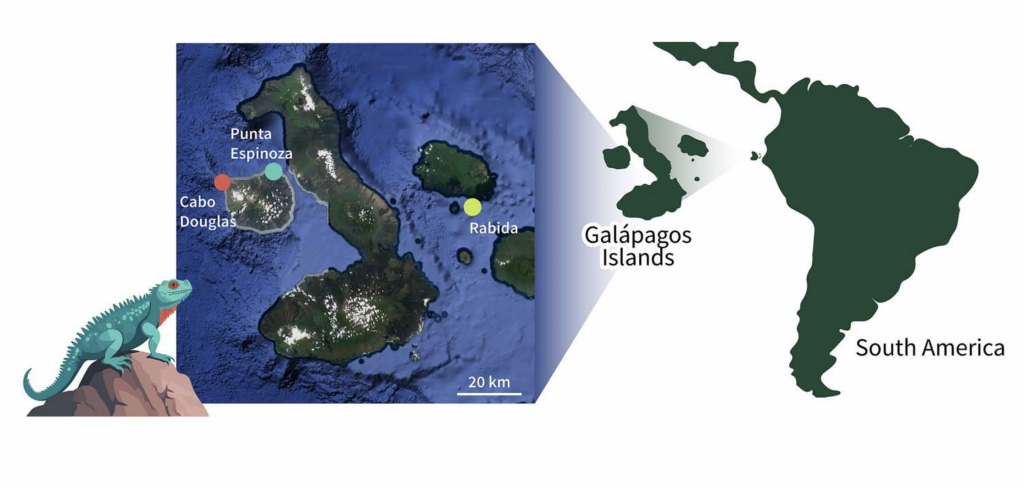
To answer these questions, we teamed up with Prof. Otto Cordero from the Massachusetts Institute of Technology, together with colleagues from the University of San Diego in Ecuador. We then spent two weeks on a boat expedition across the Galápagos, sampling iguanas directly in the field.
It was an intense and unforgettable experience, working in remote colonies, surrounded by wildlife, dramatic landscapes, and even witnessing an erupting volcano.

What we found and why it is new
What we found goes beyond simply describing which microbes are present. Some of the microbes inside marine iguanas are unique. They are endemic, found nowhere else in the world. They are distinct from global microbial datasets and even from closely related animals such as the terrestrial iguana. They appear to have evolved alongside their host, under the same isolation that shaped the iguanas themselves. In other words, the Galápagos did not just create unique animals. It also created unique microbial worlds inside them.
How these communities are shaped
When we looked at how these communities form, a clear pattern emerged. Microbes that are capable of living inside iguanas move quite freely between individuals and even across islands. There is a strong element of chance, microbes arriving and mixing, but only from a pool that can survive in the iguana environment. Once inside, everything changes. The iguana creates a strong filter. Again and again, we see the same pattern. One group of bacteria, called Clostridia, dominates most of the community. This reflects strong selection driven by the host and its diet. Only microbes that can break down algae and compete successfully are able to stay. Even those that succeed must remain very similar. Small changes are not easily tolerated, because even slight differences can make a microbe less competitive. Over time, only the best adapted and stable versions remain. Microbes can move freely, but only a very specific set can survive and persist.

A hidden layer of biodiversity
This reveals a hidden layer of biodiversity. These microbes are not just adapted. They are unique. They differ from microbes found in other animals, from global databases, and even from the terrestrial iguana. They represent a layer of life we are only beginning to understand.
Why it matters
This changes how we think about conservation, not just of animals, but of the systems that keep them alive. If an endemic species disappears, we do not just lose the animal. We also lose the entire microbial ecosystem inside it.
This connection may be fragile and potentially vulnerable to climate and environmental changes.
If the microbes themselves are disrupted, for example, by changing ocean temperatures, the iguana may no longer be able to properly digest its food. Without them, it may slowly starve. The problem can also come from the food. These microbes are highly specialized and tuned to break down algae like Ulva, the iguana’s main food. If environmental changes shift the available algae, for example toward brown algae, this system may no longer work. The animal is there, the food is there, but the connection between them is broken.
We already see how sensitive this system is. During El Niño events, when ocean temperatures rise, marine iguana populations can crash, with mortality reaching up to 90%.
There is also a brighter side. Microbes can adapt quickly and may help the iguana adjust to changing conditions. But this raises an important question. Are we protecting only what we can see, or also the hidden systems that make life possible?
Because sometimes, the most important part of an ecosystem is the part we never see.