

To be core or not to be… that is the microbial question.
Every complex system has a small set of elements that remain stable even as everything else changes. Cities rely on basic infrastructure; forests maintain characteristic tree species. Microbial gut communities follow the same pattern, and the rumen microbiome is no exception.
Hidden inside the rumen, the fermentation chamber in the upper digestive tract of cows and sheep, and the main source of the methane these animals emit, is a group of microbes that consistently appears across animals. They may hold clues to improving digestion, reducing greenhouse gas emissions, and strengthening food security. These microbes, which we first defined in 2012 as “core microbes”, have long been assumed to be important, but we had never answered the most fundamental questions about them:
What makes them so persistent, and what does “being core” actually mean for the rumen microbial ecosystem and its host? questions that carry weight across microbial ecology and gut microbiome research more broadly.
This is not just a theoretical curiosity. Ruminants, cows, sheep, goats, buffalo – are ecological and economic cornerstones of human society. Their ability to convert fibrous plant biomass into food and energy depends entirely on their gut microbes. Understanding the microbes that persist across animals throughout the world can therefore shape livestock health, productivity, and even global food security.
In earlier work, including studies on fish gut communities (Kokou et al.2019) we found that core microbes tend to support one another: they share resources and help stabilize highly dynamic ecosystems.
In our recent study, now published in Nature Ecology & Evolution (Tovar-Herrera, et al. 2025), we revisited global rumen datasets containing ~1,700 animals from around the world and identified fourteen microbial groups present in almost every ruminant on the planet. With this global rumen microbial core now defined, we could ask what enables these microbes to persist.
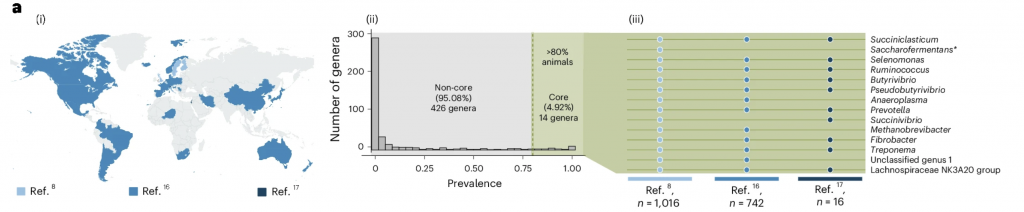
Core microbes possess a wide array of attributes, including the ability to utilize many different substrates. Importantly, they can also synthesize their own essential building blocks, amino acids, vitamins, and cofactors required for growth and survival. Because of this metabolic independence, they supply these nutrients to non-core microbes, which cannot produce them on their own, and neither can cows.
This finding is key, as it suggests that by digesting these core and non-core microbes in their stomach, cows can directly get these essential nutrients which they cannot produce themselves.
Because core microbes can utilize a wide array of substrates and produce what they need to survive, they are essentially functional generalists, independent and better colonizers, allowing them to thrive across animals and conditions.
Their persistence ensures a steady supply of essential nutrients to the host and helps maintain the tight partnership between ruminants and their microbiomes.
But why should core microbes provide nutrients to non-core microbes and even to the host? Well… core microbes are not trying to feed anyone; they just play it safe, simply enjoying the luxury of being truly “self-sustaining” across many ruminant species.
An even more difficult question is: why would non-core microbes take the risk of becoming dependent on core microbes for their survival? A potential answer lies in the Black Queen Hypothesis. This theory posits that by shedding costly metabolic functions, non-core microbes save energy by relying on others to supply essential metabolites. And if you think about it, this dependency is not really a risk…because core microbes are always there.
The same holds for cows and other ruminants: they essentially “trust” their core microbes for survival, and these microbes never fail them. In return, core microbes receive a stable, protected habitat in the rumen with a constant supply of food. This creates a remarkable symbiosis, one that has supported human societies for millennia.
This makes core microbes the functional pillars of the rumen ecosystem: not just microbes that are found in every ruminant, but functional generalists that provide essential nutrients and help hold the system together.
In a world where food security and climate stability face increasing pressure, these insights are more than interesting, they are essential.
Understanding why core microbes persist, and how they sustain their ecosystem, opens the door to new applications. By modulating these microbial components, which exist in almost every ruminant in the planet, the impact can be huge. We may improve digestive efficiency, design microbiome-based feed strategies, enhance resilience to dietary shifts, and ultimately reduce methane emissions while supporting global food production.