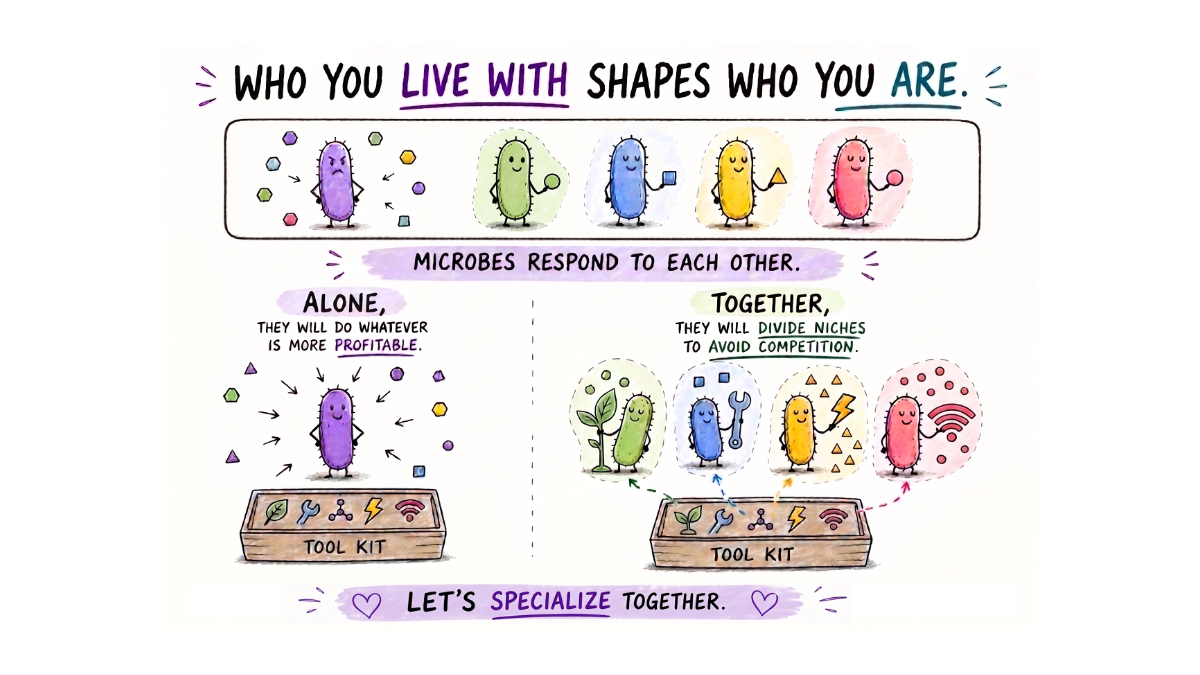

In our new perspective in Trends in Microbiology, we argue that understanding microbial communities requires moving beyond flat, two-dimensional views.
Microbes don’t live on slides. They live in structured, three-dimensional worlds.
And in these environments, who is next to whom, who interacts with whom, and where these interactions happen can fundamentally shape function. Spatial structure influences how metabolites diffuse, how signals are exchanged, and which organisms are able to coexist within the same niche. Even neighboring cells of the same species may experience very different local conditions.
A few microns can separate cooperation from competition, nutrient exchange from isolation, or activity from dormancy. Spatial organization creates microscale environments with distinct chemical gradients, metabolic niches, and interaction networks that are often invisible in bulk measurements. These gradients can change dramatically over extremely small distances, creating pockets of activity that cannot be captured by homogenized sampling approaches.
Many microbial processes are inherently local. Cross-feeding, syntrophy, quorum sensing, and electron transfer often depend on physical proximity between cells. As a result, spatial arrangement can strongly influence the stability and productivity of entire microbial communities.
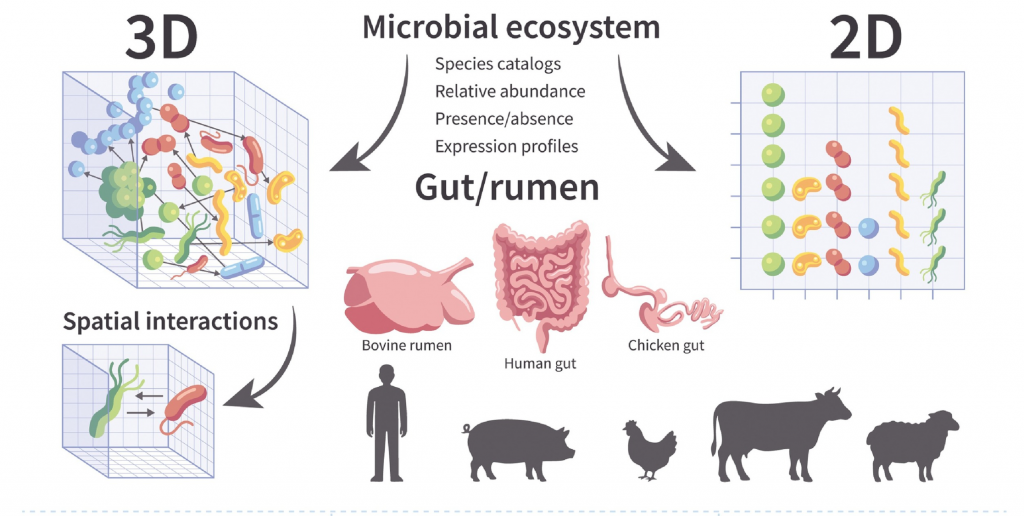
We highlight emerging approaches that allow us to study microbial communities in their native spatial context, integrating community composition, gene content, expression profiles, and ecological interactions. Advances in imaging, microscale sampling, and spatially resolved omics are now allowing researchers to investigate microbial ecosystems without disrupting their natural architecture.
These new approaches are beginning to reveal microbiomes not simply as collections of species, but as highly organized ecosystems shaped by physical structure and local interactions. They also provide an opportunity to connect microbial ecology with broader ecological theory, linking spatial organization to community assembly, resilience, and ecosystem function. This perspective may also help explain why communities with similar compositions can behave very differently under changing environmental conditions.
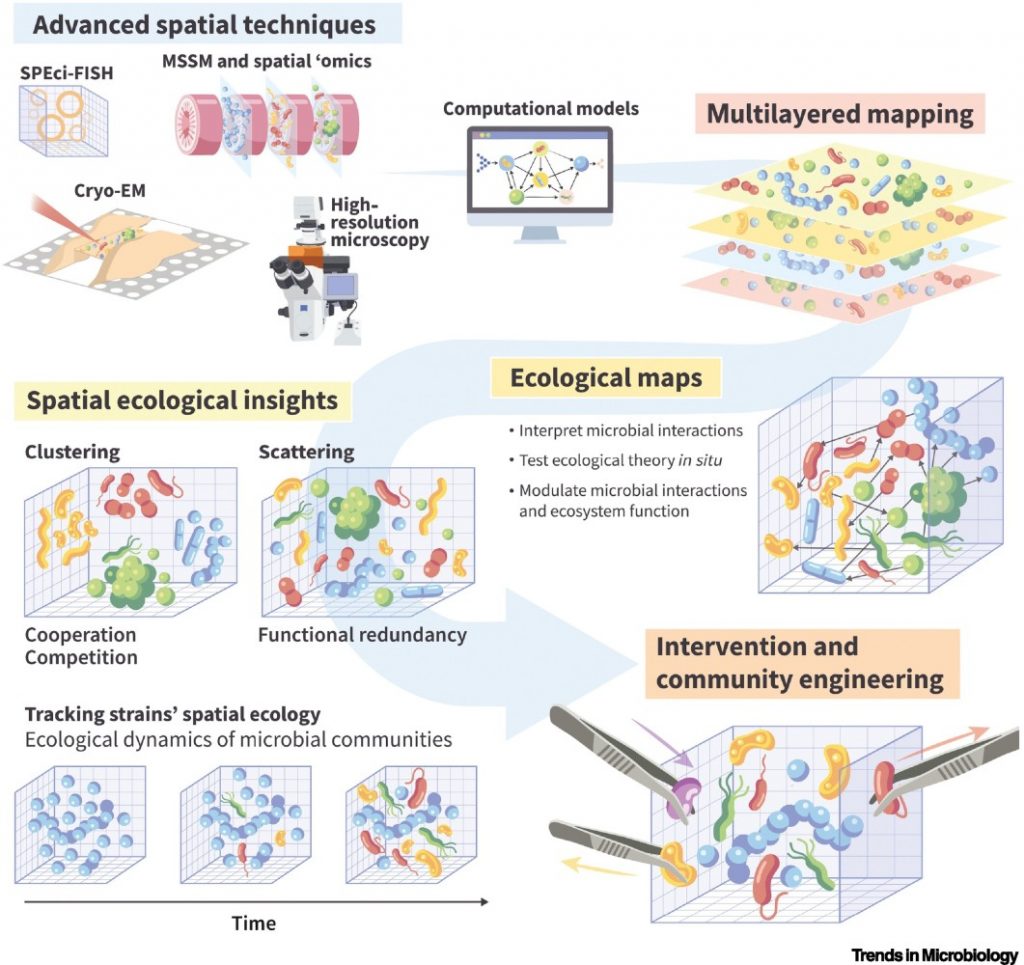
Importantly, spatial context may influence evolution itself, shaping cooperation, diversification, and the spread of adaptive traits within microbial populations. Understanding these spatial dynamics could therefore improve our ability to predict and eventually engineer microbiome behavior across environments ranging from soils to animal hosts.
This shift opens the door to testing ecological theory in situ, better interpreting microbial interactions, and ultimately guiding microbiome function in natural systems.
To conclude: a new ecological paradigm is taking shape, one where space is not just context, but a driver of function.
If you’re interested in how microbial communities are organized, and how we can better understand and steer them across environments, you’ll find this perspective interesting!